Oceanic slope of Aigoual
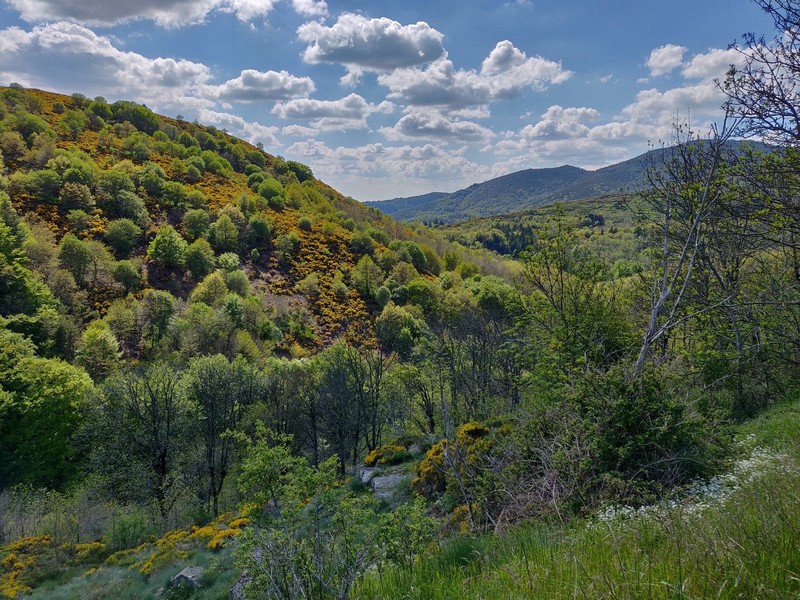
A ride through the Cévennes, exploring an area that is still wild and unspoiled. Small roads, pretty villages and hamlets, profound gorges, arid plateaux: a multitude of landscapes in just one day.
11 points of interest
Village de l'Espérou - Béatrice Galzin  History
The village of L’Espérou
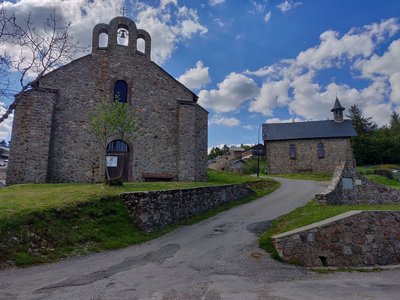
The village of L’Espérou lies on the border of Dourbies and Valleraugue local councils. A draille (track for livestock to migrate to summer pastures with their shepherds) crosses the village. As in many villages in the Gard, the two places of worship – one Catholic, the other Protestant – are opposite each other. The village is located in a varied environment that is suitable for outdoor activities and sports.
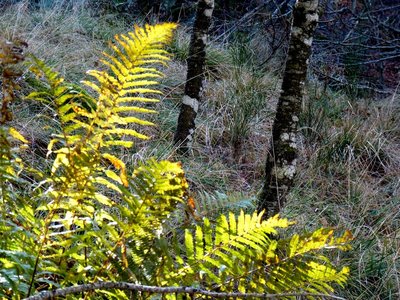
La fougère aigle - Béatrice Galzin  Natural environment
The hidden life of the forest
Trees grow upwards towards the light while mosses benefit from their shade on the ground and spread out. Like soft cushions or carpets, they hug everything that sticks out of the ground, such as old tree stumps. This soft felted surface is pleasing to see, and an undergrowth without mosses would not be worthy of the name. Legend has it that mosses show which way is north. Wrong!
Mosses indicate a degree of moisture; they protect the soil from drying out by retaining every last drop of dew. They prepare pockets of humus for the future occupants: grasses and herbaceous plants. They also love the damp of tree trunks and can grow there, on the side that is most exposed to the prevailing rains.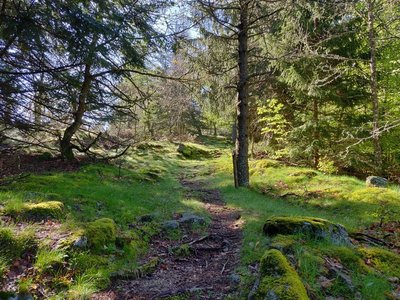
Sous bois du Trévezel - Béatrice Galzin Natural environmentThe Mont Aigoual forest
“Aigoual, Forêt d’Exception”
The French Forestry Office, which manages state forests, launched a programme in 2013 called “Aigoual, Forêt d’Exception” (Aigoual: An Exceptional Forest) with the aim of highlighting the massif’s natural and cultural heritage. The Forestry Office thus tries to foreground the different aspects of its multi-facetted management: production, protection and receiving visitors. One key aspect of this approach, which complements other initiatives by local actors, is to improve visitors’ experience in the forest.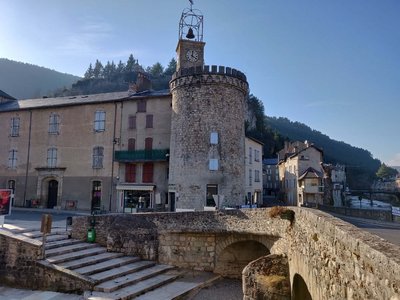
Le centre de Meyrueis et sa tour - Béatrice Galzin  Architecture
The village of Meyrueis
The geographical location of Meyrueis is remarkable, nestled between the Aigoual massif, the causse Noir and the causse Méjean. Here the Camin Ferrat crosses the Jonte river. Pilgrims and transhumant flocks of sheep stopped in the village before continuing their journey. Many merchants came to its large fairs. Stroll through the lanes and relive the flourishing past of the belle époque. From the prosperous bourgeois residences to the marketplaces, everything still speaks of the past! Sheep’s wool from the plateaux was woven here, silk was spun. There was intense economic activity. In the 17th century, Meyrueis became a centre for hat-making. By 1860, 17 milliners were busy making hats for Languedoc and Provence, beautiful and exceptionally high-quality hats made from felted wool and silk bourette. Discontinued as of about 1920, this activity left room for tourism, which today animates the village.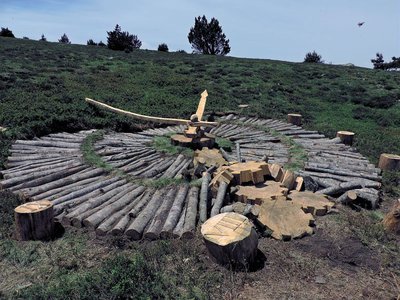
Tempus fugit (Fiona Paterson, Donald Buglass) - © Natacha Maltaverne HistoryTempus Fugit (Fiona Paterson, Donald Buglass)
Time flies, conscience cries, death threatens, heaven invites, hell scolds, and man sleeps. Here, the effects of time and natural elements transform the wood used in the artwork; everything is an endless renewal at the same rate as the passing hours. How much time have we got left before everything is lost and it is too late to repair the damage? Nature will continue on its trajectory and efface the traces of Humanity on Earth.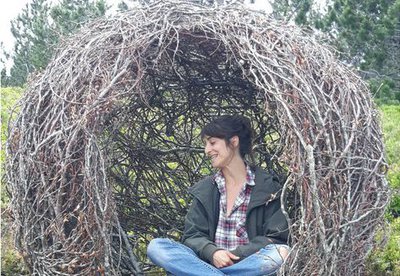
Cellule (Marie Gueydon de Dives) - © Filature du Mazel  Landscape
Cell (Marie Gueydon de Dives)
This artwork, natural in architecture but artificial in execution, represents a passage between the interior and exterior worlds. Posing or opposing while questioning the notions of limit, porousness and opening.
This work encourages you to come inside but feel outside. To be the contemplative eye, the receiving ear, the conscience that objectifies reality.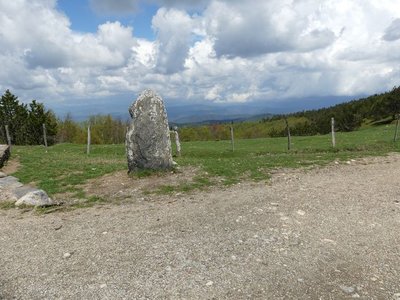
Vue depuis Font de Trépaloup - nathalie.thomas  Flora
FloraThe evolution of plant life
At the pass stands a schist menhir (standing stone). To the north, in Trépaloup ravine, hewn flint implements bear witness to a human presence in the region since prehistoric times. Palynological analyses (studies of pollen fossilised in peatbogs) have allowed scientists to piece together the plant life on Mont Aigoual from 8,000 to 5,000 BC. Pine predominated, accompanied by birch and hazelnut. Then pine populations gradually diminished. The damp climate warmed up, favouring the spread of oak and hazelnut. Finally, the increased damp and cloud cover at altitude allowed fir and beech to develop. From the end of the first century BC, the substantial percentage of grasses shows that forest had receded in favour of pasture and prairies. This was the start of the great deforestation.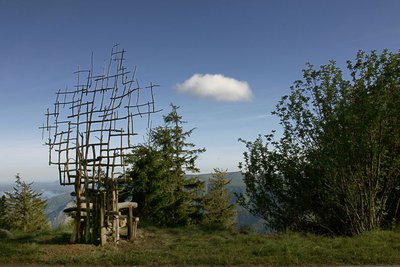
Assise (Marie-Hélène Richard) - © Filature du Mazel LandscapeSeated (Marie-Hélène Richard)
Far from town, paths open the door to new rhythms. Another vision of life and time lets us breathe in the ever-present contemplation, stones, trees and skies. A physical experience of coming face-to-face with nature. A bench made of wood and branches, whose back becomes thinner as it rises towards the sky, as if to turn back into a tree.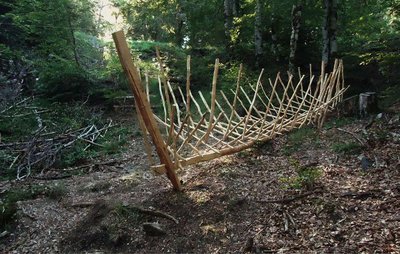
Bassin versant (Xavier Réche) - © Filature du Mazel  Water
WaterCatchment Area (Xavier Rèche)
By its location and name, this installation evokes the nearby watershed between the Atlantic and Mediterranean. A vessel reduced to a suspended wooden framework, without strakes or gunwale, tilts in the direction of the runoff. It emphasises the first branches of a gigantic drainage system.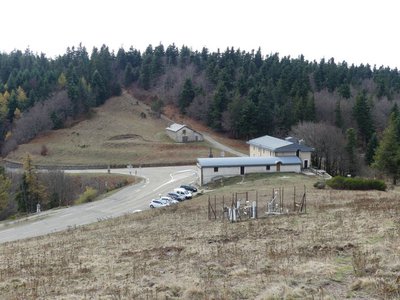
La Serreyrède - nathalie.thomas WaterClimate frontier
The pass is also a climate frontier. The Atlantic side is predominantly exposed to the west wind and receives rainfall that is fairly regularly spread over the year. The Mediterranean side, however, is drier and hotter and constitutes a massive barrier to the occasional southeast wind (the marin), thus forcing its humid air to rise suddenly. This makes the clouds’ water content condense, which can give rise to so-called Cevenol episodes: heavy rainfall (600 mm in 24 hrs) causing catastrophic floods. The Aigoual, Mount Aigualis the rainy (A. Bernard), is well-named! After Savoie, it is the rainiest place in France.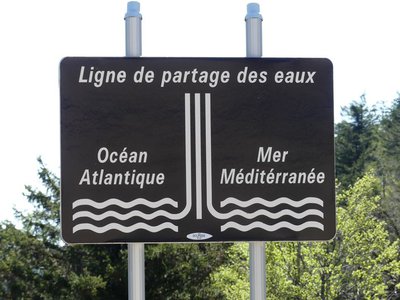
Ligne de partage des eaux - nathalie.thomas  Geology
The watershed
The current relief creates a frontier between the Atlantic and the Mediterranean: depending on the slope, water runs towards either the Ocean or the Sea. This is due to the uplift of the Cevenol sill, brought about by geological activity along the Cévennes fault, which borders draw the northern limit of the Languedoc region. This natural sill marks the geographical border between the northwest slope – verdant, not too steep – and the southeast slope, which falls away abruptly in the Languedoc and continues to be subject to powerful erosion.
Description
At the L’Espérou roundabout, bike to Dourbies on the D151.
- After the village of Dourbies, continue on the D151 to the Col des Rhodes pass.
- At the Col des Rhodes pass, take the D170 towards St-Sauveur-Camprieu via the Col des Ubertes pass to reach the D986.3)
- Turn towards Lanuéjols on the D986 and then the D263. Cross Lanuéjols and at the roundabout, turn right towards Meyrueis on the D47 and then the D986.
- As you leave Meyrueis, climb to the Col de Perjuret pass going towards Florac-Trois-Rivières on the D996.
- At the Col de Perjuret pass, go uphill to the summit of Mont Aigoual on the D18 via Cabrillac.
- At the summit, take the track closed to motorised vehicles that takes you below Mont Aigoual via Font de Trépaloup. Then join the D269 to go downhill to the Col de La Serreyrède pass. Return to L’Espérou on the D986.
- Departure : L'Espérou
- Arrival : L'Espérou
- Towns crossed : Dourbies, Trèves, Lanuéjols, Saint-Sauveur-Camprieu, Meyrueis, Gatuzières, Fraissinet-de-Fourques, Rousses, Bassurels, and Val-d'Aigoual
Forecast
Altimetric profile
Recommandations
Before committing yourself to a circuit, ensure that it is suitable for your activity level and ability. Respect traffic laws and other road users; stay in control of your speed and trajectory. Make sure to be seen and travel in single file when in a group. Remember that the weather changes quickly in the mountains. Take enough water. Safe trip !
Information desks

Tourism & national parc'house
Col de la Serreyrède, 30570 Val d'Aigoual
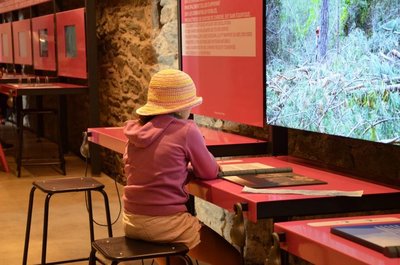
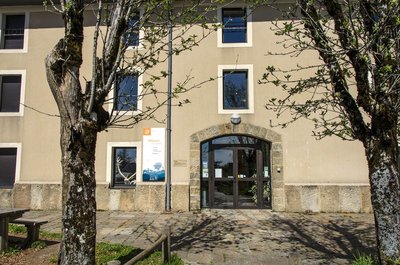
The Maison de l'Aigoual houses the tourism office Mont Aigoual Causses Cévennes and the Maison du Parc national. This visitor centre provides information on and raises awareness of the Cévennes National Park, its sites and events as well as the rules that must be observed in the National Park's central zone.
On site: changing exhibitions, video projections, Festival Nature events and shop Open year-round
Access and parking
From Meyrueis or Valleraugue, take the D986 to L’Espérou.
Parking :
Calculateur d'itinéraire Lio
Utilisez le calculateur liO pour organiser votre trajet en région Occitanie.
Autres régions
Calculez votre itinéraire en Auvergne Rhône Alpes sur Oùra
Biodiversité autour de l'itinéraire
Report a problem or an error
If you have found an error on this page or if you have noticed any problems during your hike, please report them to us here: