
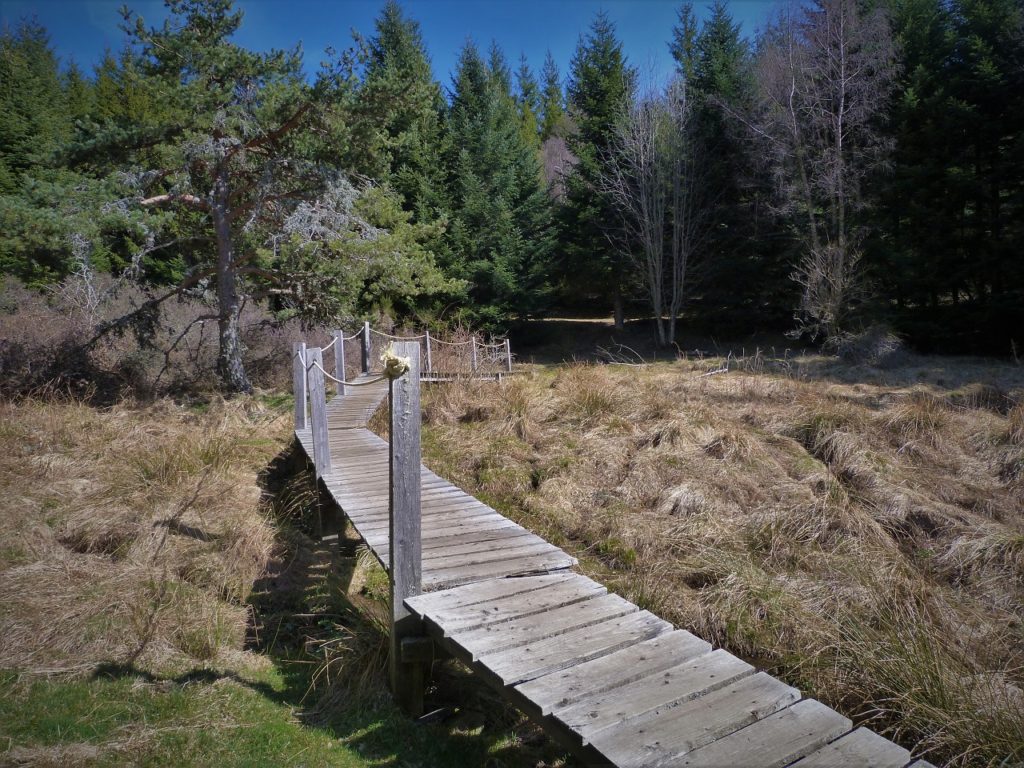
The springs of the river Lot
 Yellow waymarks
The objective is to discover the spring of the river Lot, but that won’t stop you from finding out more about rye, the short-toed treecreeper, mushrooms or Robert Louis Stevenson.
6 points of interest
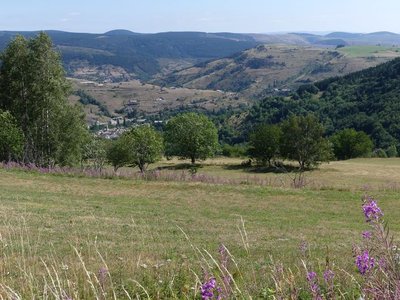
Cubières depuis le Causse - nathalie.thomas  History
Cubières
This village, which was founded long ago, owes its name (cubereis) to the copper that the Gallo-Romans mined here. In the Middle Ages, under the protection of the local lord, villagers had to mill flour and then bake their bread in the shared bread oven, which was the property of the Seigneur du Tournel. Whenever they did so, he received a tax called the ban. This feudal right was abolished during the French Revolution, and the oven simply became the village oven.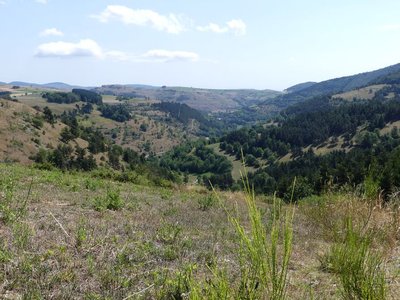
Le Rieutord - © Nathalie Thomas  Geology
The Rieutord
This brook is the Rieutord, which flows into the Altier, a tributary of the Chassezac. Amateur geologists will notice that you are here on the boundary between a limestone pocket on the right, schist (slate) on the right and granite at the summit. The three bedrocks determine the landscape and its vegetation. The limestone is a maritime memento from the Jurassic. The schist was formed in the heat of considerable depths and pushed to the surface by earthquakes during the Quaternary Period. The granite is former magma that made its way through the schist from deeper still to become the surface of Mont Lozère.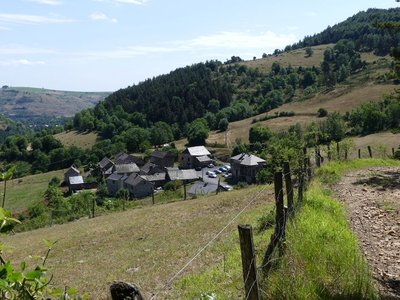
Neyrac - nathalie.thomas HistoryMule trains
You are at a crossroads; one of the tracks is the former road from Mende to Villefort, which veers off the Route des Arvènes (the Régordane) at La Maloutière (as you leave Villefort). How many mule trains – convoys of at least six laden mules – passed here over the centuries, their bells ringing! The mule drivers passing in their caravans brought life to the village and gave Cubières a look of prosperity. The village road was very commercial, aligning inns and shops.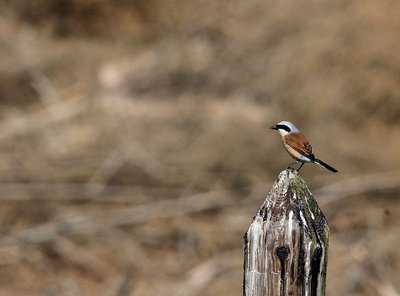
Pie-grièche écorcheur - Régis Descamps  Fauna
FaunaPasserine birds
Open spaces with a few trees and bushes favour passerine birds. Passerines are the largest and most varied order of birds, containing over half of all bird species. The red-backed shrike in particular likes this environment, which abounds in the large insects that constitute its main food source. The shrike is strictly migratory and hibernates in eastern Africa.
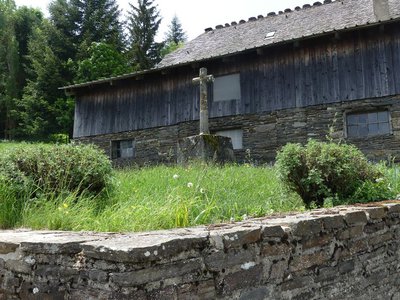
La croix des missions - Nathalie Thomas HistoryThe “mission” cross
In the municipality of Le Bleymard, there is a large number of crosses and other small religious heritage elements, which bear witness to inhabitants’ fervour in the old days. You will see them as you enter villages, on main squares and at crossroads, to protect the walker and ploughman. Offerings sometimes took the form of crosses, which were then called “mission” crosses.
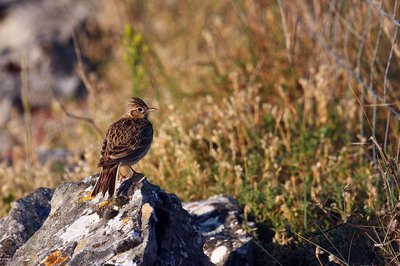
Alouette des champs - Régis Descamps FaunaThe Eurasian skylark
The Eurasian skylark has a characteristic song, which it delivers during its ascending flight, sometimes for several minutes without a break.
A migrating bird, it has brown feathers with darker stripes. It has a plump body and rather short, wide and pointed wings. Its belly is a creamy white and its chest tan with brown-black stripes.
Description
Signposts will guide you all along this route, as well as yellow painted waymarks. In the description below, the signposted place names and/or directions are given in bold italics between quotation marks :
Starting at “CUBIÈRES”, walk to :
- “Le Réservoir”,
- “Col Santel”, turn right towards “Eglise du Bleymard”.
- At “Eglise du Bleymard”, turn right to “SOURCES DU LOT” via :
- “Croix de la Mission”,
- “La Remise”,
- “Les Alpiers”,
- “SOURCES DU LOT”, go to :
- “Chap Duolt”,
- “Lou Feyra”, turn left to :
- “Frachassou”,
- “La Mourade”,
- “COURSOULES”, go to :
- “COL BOURBON”,
- “Valat de la Longogne”,
- “Croix de Pelloufet”,
- "Pelloufet"
- “Village”.
This hike is taken from the guidebook Mont Lozère – Pays des sources, de la montagne du Goulet aux gorges du Bramont, published by the Pôle de pleine nature du Mont Lozère.
- Departure : Cubiérettes
- Arrival : Cubiérettes
- Towns crossed : Cubières, Mont Lozère et Goulet, and Cubiérettes
Forecast
Altimetric profile
Recommandations
Make sure your equipment is appropriate for the day’s weather conditions. Remember that the weather changes quickly in the mountains. Take enough water, wear sturdy shoes and put on a hat. Please close any gates and barriers behind you.
Information desks

Tourism office Mont-Lozère, Bagnols-les-Bains
avenue de la gare, 48190 Bagnols-les-Bains Mont-Lozere et Goulet
This office is part of the National Park's associated tourist-information network, whose mission is to provide information on, and raise awareness of, the sites and events as well as the rules that must be observed in the National Park's central zone. Open from mid-April to late September

Place de l'église - Le Bleymard, 48190 Mont Lozère et Goulet

Tourism office Mont-Lozère, Villefort
43, Place du Bosquet, 48800 Villefort
This office is part of the National Park's associated tourist-information network, whose mission is to provide information on, and raise awareness of, the sites and events as well as the rules that must be observed in the National Park's central zone.
Open year-round
Access and parking
From Mende, drive towards Villefort on the N88 then the D90; 5 km after Le Bleymard, turn right to Cubières
From Villefort, drive towards Le Bleymard on the D901; 13 km after Altier, turn left to Cubières
Parking :
Calculateur d'itinéraire Lio
Utilisez le calculateur liO pour organiser votre trajet en région Occitanie.
Autres régions
Calculez votre itinéraire en Auvergne Rhône Alpes sur Oùra
Biodiversité autour de l'itinéraire
Source



Report a problem or an error
If you have found an error on this page or if you have noticed any problems during your hike, please report them to us here: