
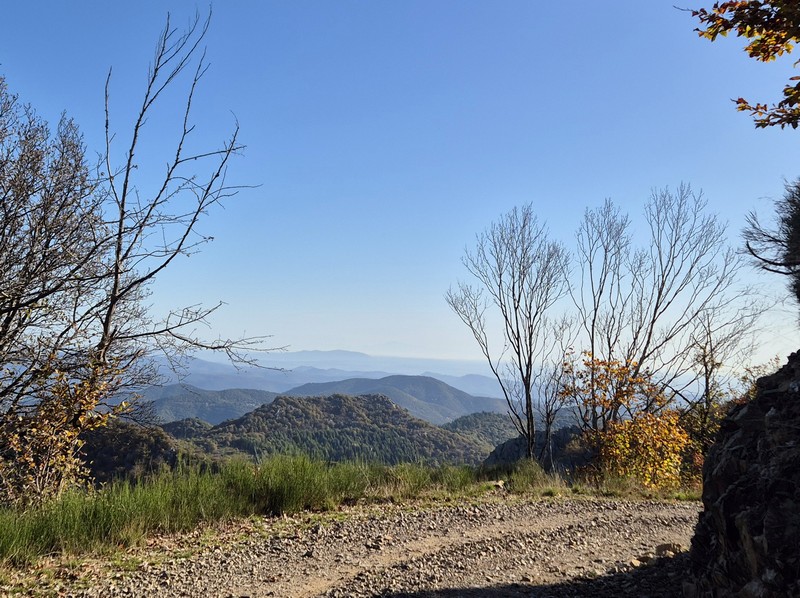
On Fageas ridge – 4 days
 Yellow waymarks
 GR (long-distance hiking path)
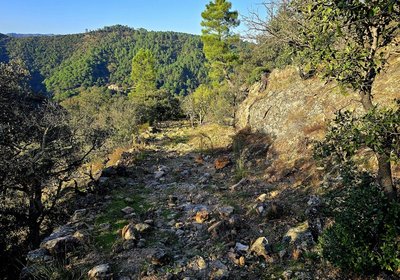
These ridge paths were once vital traffic arteries between the valleys. Some houses in ruins still stand along the tracks. They used to be taverns, cafes or just refuges for travellers passing through or else shepherds migrating up to summer pastures with their sheep. These were meeting-points where news was exchanged and connections between the mountains’ inhabitants forged.
4 steps
9 points of interest
© Béatrice Galzin  Water
WaterOne spring, five fountains
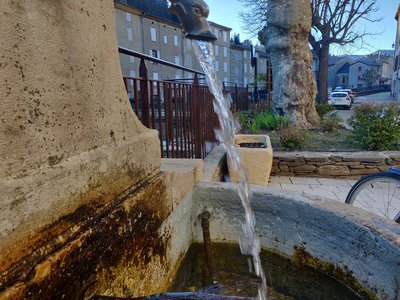
This fountain is one of Saint-André’s five public fountains, all of which are supplied by the same spring (its water is thus the same as in the Fontaine du Griffon). Before houses were connected to mains water, there were many more fountains on this side of the quay.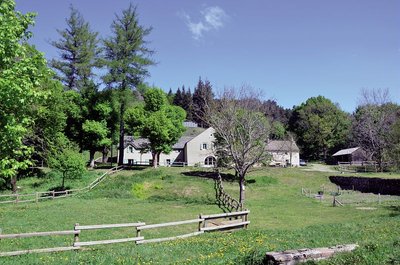
Aire de Côte - Stephan.Corporan  History
Aire de Côte
Aire-de-Côte farm was purchased by the French State in 1862, during the period of reforestation. Before the farm became a stopover gîte, it was for a long time the residence of the local forester and his family. In the first half of the 20th century, Aire-de-Côte was very different. To the north, behind the house, was the draille (drovers’ road), lined by upright stones and 40 to 50 metres wide. Thousands of transhumant animals passed every year on their way to or from summer pastures. The transhumant animals stopped there at lunchtime, then continued on towards Mont Aigoual.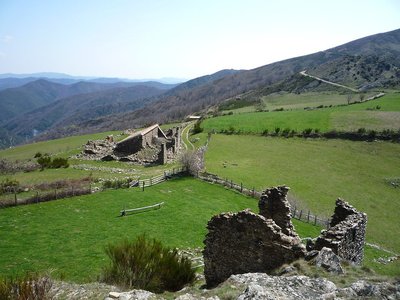
Les prairies de Bonperrier - Michel Monnot AgricultureBonperier
The etymology of this name is believed to be “good fields”. Indeed, there are fields surrounding the hamlet that are still maintained today. It is said that the hamlet’s inhabitants grew cereals. After harvest, they would take the wheat and rye down to the mill in the village. The oats, however, stayed in the hamlet as livestock fodder.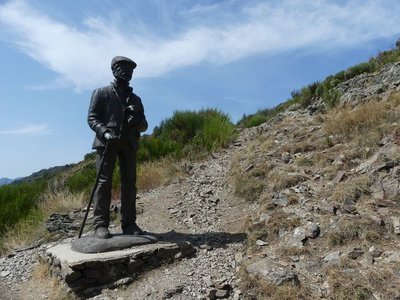
Le pastre - Nathalie Thomas AgricultureThe draille (drovers’ road) and the sheep bridge
The draille (drovers’ road) and the sheep bridge architecture The sheep bridge at the Col de l’Asclier is on an important draille (a traditional path for livestock migrating to the upland summer pastures of Mont Aigoual and Mont Lozère), which was also a King’s road during the Camisard revolt in the 18th century, a peddlers’ road and is now a long-distance hiking path. The Col de l’Asclier pass (from Occitan asclar, to split), where the road seems to go through a gap, is well-named: it lies on a fault line in the rock. But the most astonishing is the bridge, a bridge without road. It was built to help sheep flocks negotiate this difficult spot!
 Flora
FloraThe forestry track
On the first two kilometres, up to the Rocher de l'Aigle, you are on the forestry track opened in 1938. Where there are forestry tracks, there are state-owned forests, meaning forests managed by the French state and the Office National des Forêts so as to develop the area. The presence of so many beech trees and pines is a marker of the previous reforestation policy on the Aigoual massif and in the Cevenol foothills. A plaque has been erected at the Col du Fageas pass, further along this trail, in memory of Max Nègre (1880 – 1960), one of the project managers of this collective undertaking. From 1935 to 1939, he thinned out the forests planted since the end of the 19th century and opened up forestry tracks.
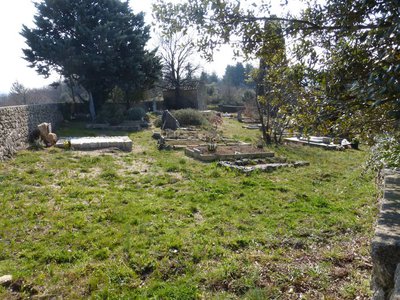
Cimetière communal - © Nathalie Thomas HistoryCemetery history
The walk leads you past the village cemetery, which was in fact the Protestant cemetery. Soudorgues also has a Catholic cemetery, another particularity brought about by the turbulent history of the Reformation. Catholic cemeteries did not accept “non-Christians” or “heretic Christians”. There were countless exhumations of Protestant bodies in the 16th century. To put an end to this injustice, the Edict of Nantes ordered that “convenient” cemeteries be built for those who followed the so-called reformed religion. When the Edict was revoked, the order was also dropped. Huguenots had to renounce their religion to be buried in 'family” cemeteries in the countryside. Today, only the owners of these on-site cemeteries still have the right to be buried in them.
 Know-how
Lime kiln
The process of burning limestone to make lime has been used since the Bronze Age. The lime was mixed with sand to make mortar for building houses. Concrete was not known until the early 19th century. Lime is also a powerful antiseptic and was used to disinfect buildings, especially sheepfolds. The kiln operator had to maintain the kiln temperature at 800 to 1,000°C. Plaster was made from gypsum deposits using the same principle.
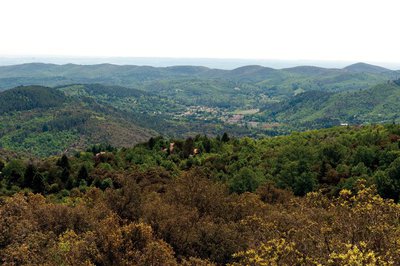
Vue des crêtes de Mauripe - © Olivier Prohin  Landscape
360° views from Mauripe
From here, on a clear day, you can see the Alps (west) and the Mediterranean (south). Looking northwest, you can make out Mont Aigoual, the Col de l'Asclier pass, the Col de Fageas with its television mast and, if you follow the ridges eastwards with your eyes, the Rocher de l'Aigle, Piécamp and La Mortière. The lowest ridge is the famous Corniche des Cevennes. Behind it, further east, are the mountain ranges of La Vieille Morte and Le Mortissou, and, in the far distance, the ridges of Mont Lozère. Far to the south, you can make out the city of Alès and, even further away, Mont Ventoux. In front are the town of Lassalle and then La Fage mountain above Saint-Hippolyte-du-Fort. On the horizon, the Mediterranean shimmers furtively.
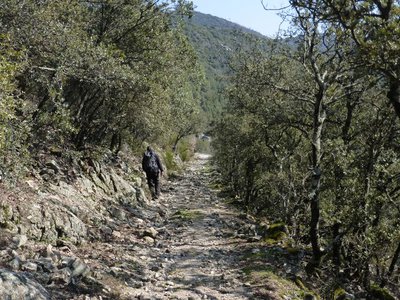
Descente au col de Mercou - © Nathalie Thomas AgricultureDraille
The rocky path becomes wider and has stone reinforcements on the downhill side, which shows that it was once used by large herds. This draille led from Saint-Jean-du-Gard to the summer pastures on Mont Aigoual. At the Col de Mercou pass (570 m), there are panoramic views northwards over the Corniche des Cevennes. The pass was once a site for trade and commerce, with its own market. Its name is derived from Mercury, the god of travellers and commerce. There are also references to Melkart, a Phoenician deity: Semitic traders left traces of their passage here in the architecture of the old proto-historic bridges. Melkart or Melqart was the tutelary god of the city of Tyre - whose name means “strong king” in Phoenician – and was the god of riches, industry and navigation. He was worshipped in the tenth century BC.
Description
- Day 1 : Saint-André de Valborgne - Aire de Côte (yellow waymarks, then red-and-white GR®7) : 13.8 km.
- Day 2 : Aire de Côte - Mas Corbière on the GR® 6-67 (red-and-white waymarks) : 13.9 km.
- Day 3 : Mas Corbière - Soudorgues, on the GR®67, GR®61 and GR®63 (red-and-white waymarks) : 17.8 km.
- Day 4 : Soudorgues - St-Jean du Gard via Mont Mercou (yellow waymarks, then red-and-white GR®61 : 13.3 km.
- Departure : Saint André de Valborgne
- Arrival : St Jean du Gard
- Towns crossed : Saint-André-de-Valborgne, Bassurels, Val-d'Aigoual, Les Plantiers, L'Estréchure, Soudorgues, Peyrolles, and Saint-Jean-du-Gard
Forecast
Altimetric profile
Recommandations
Make sure your equipment is appropriate for the day’s weather conditions. Remember that the weather changes quickly in the mountains. Take enough water, wear sturdy shoes and put on a hat. Please close any gates and barriers behind you.
Where to sleep :
Aire de Côte : oficial bivouac area (composting toilets, water); no food available on-site. 09 70 03 56 62, contact@airedecote.fr https://airedecote.fr/
Mas Corbières : 06 22 72 14 78 contact@mascorbieres.com www.mascorbieres.com/
Stopover in Soudorgues :
Gite Longitude : 04 66 85 07 89 gitelongitude30@gmail.com www.gite-longitude.com
Le Petit Pavillon des Cévennes accueil@lesfaissesencevennes.fr www.lesfaissesencevennes.fr
Information desks

Tourism & national parc'house
Col de la Serreyrède, 30570 Val d'Aigoual
The Maison de l'Aigoual houses the tourism office Mont Aigoual Causses Cévennes and the Maison du Parc national. This visitor centre provides information on and raises awareness of the Cévennes National Park, its sites and events as well as the rules that must be observed in the National Park's central zone.
On site: changing exhibitions, video projections, Festival Nature events and shop Open year-round

Tourism office Cévennes Tourisme, Saint-Jean-du-Gard
Maison rouge, 30270 Saint-Jean-du-Gard
This office is part of the National Park's associated tourist-information network, whose mission is to provide information on, and raise awareness of, the sites and events as well as the rules that must be observed in the National Park's central zone.
Open year-round

Tourism office Mont Aigoual Causses Cévennes, Lassale
Centre Viala, rue de la Place, 30460 Lasalle
This office is part of the National Park's associated tourist-information network, whose mission is to provide information on, and raise awareness of, the sites and events as well as the rules that must be observed in the National Park's central zone. : Open year-round

Tourism office Mont Aigoual Causses Cévennes, Saint-André-de-Valborgne
les quais, 30940 Saint-André-de-Valborgne
This office is part of the National Park's associated tourist-information network, whose mission is to provide information on, and raise awareness of, the sites and events as well as the rules that must be observed in the National Park's central zone.

Tourism office Mont Aigoual Causses Cévennes, Valleraugue
7 quartier des Horts, 30570 Valleraugue
This office is part of the National Park's associated tourist-information network, whose mission is to provide information on, and raise awareness of, the sites and events as well as the rules that must be observed in the National Park's central zone. : Open year-round
Transport
This hike is accessible by public transport.
At Saint Jean du Gard - La Poste (post office), you can park your car and take the bus to Saint André de Valborgne.
For up-to-date bus times and to plan your journey, use the itinerary calculator below for your destination bus stop : SAINT-ANDRE-DE-VALBORGNE-Fontaine
Access and parking
From St-Jean-du-Gard towards St-André de Valborgne on the D907 via the villages of L’Estréchure and Saumane.
Parking :
Calculateur d'itinéraire Lio
Utilisez le calculateur liO pour organiser votre trajet en région Occitanie.
Autres régions
Calculez votre itinéraire en Auvergne Rhône Alpes sur Oùra
Biodiversité autour de l'itinéraire
Source


Report a problem or an error
If you have found an error on this page or if you have noticed any problems during your hike, please report them to us here: