From Meyrueis to the summit of Mont Aigoual.
 GR (long-distance hiking path)
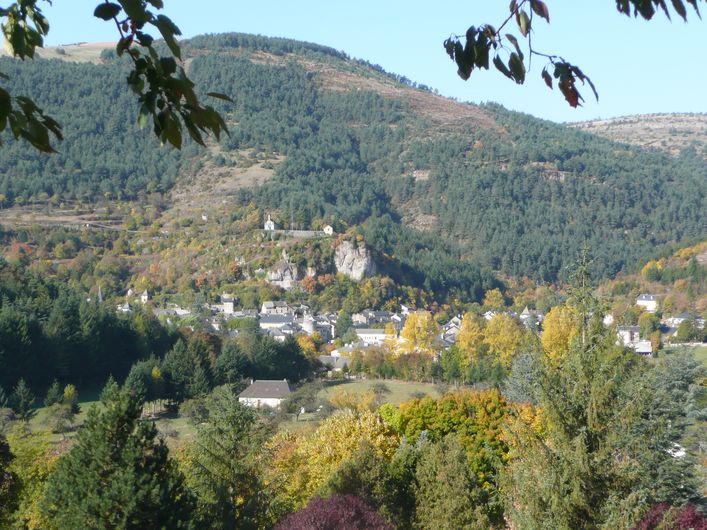
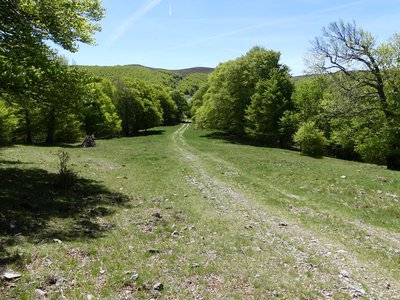
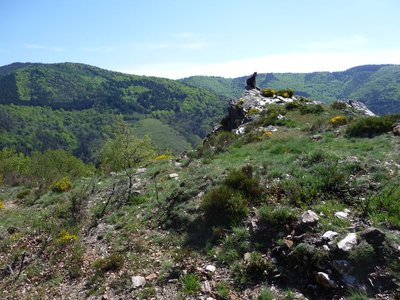
You leave Meyrueis, a market town built at the confluence of three rivers, to immerse yourself in a beech forest with some rather crooked trees that alternates with upland grasslands. As well as the vista from the summit, this hike also offers panoramic views onto the Causses plateaux and the Brèze and Béthuzon valleys.
2 steps
16 points of interest
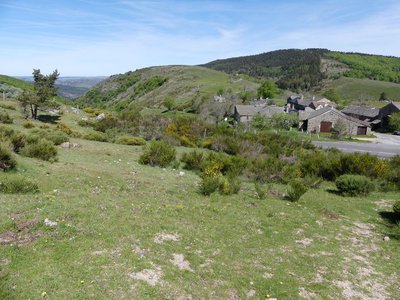
Cabrillac - nathalie.thomas  History
Cabrillac
Cabrillac was located at the crossroads of the grande draille d'Aubrac (Aubrac drovers’ road) and the road from Meyrueis to Florac and St Jean du Gard. The village had about a hundred inhabitants in the 20th century and was an important and inevitable place of transit. Two fairs were held every year: one during the migration to the summer pastures in May; the other in September, during the return. For some shepherds, this was the occasion to sell the lambs that had spent the summer on the Aubrac plateau.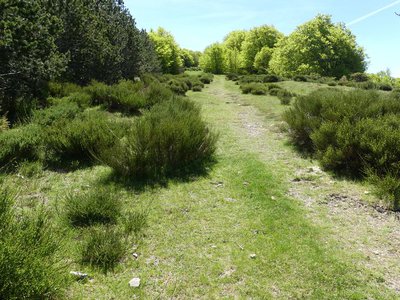
Draille de Cabrillac - nathalie.thomas AgricultureThe Aubrac drovers’ road
From Cabrillac, we follow the Aubrac drovers’ road, which started near Ganges (Hérault) to lead flocks onto the Aubrac pastures, a distance of 110 km. If you climb to the top of Mont Aigoual (2 hrs), you can visit the meteorological observatory and meet transhumant flocks. Be careful of the patous (livestock guardians).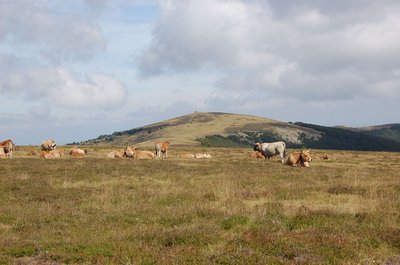
Troupeau au sommet de l'Aigoual - © Nathalie Thomas  Flora
FloraSummit of Mont Aigoual
At an altitude of 1,565 m, the climate is harsh: weather conditions are the same as they would be at 2,000 m elsewhere, with only four “frost-free” months a year. Winds of above 60 kph blow on 265 days a year, and the average annual temperature is 4.8°C. Trees do not have enough time to complete their life cycle. Local plant formations are those of the montane zone: subalpine short-grass prairies.
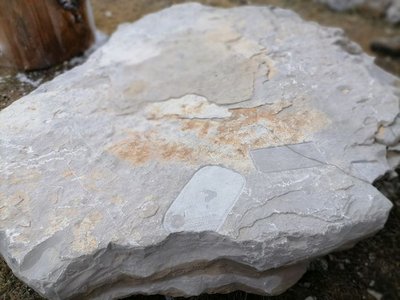
Archéosmart (Marc Limousin) - © Filature du Mazel  Archaeology
Archeosmart (Marc Limousin)
Smartphone imprints appear on the rocks: fossils of the present that will become mysterious in the future. This carved stone, like the cup-shaped marks and other rock art of the region, discloses history revealed in matter and resonates with Malraux’s phrase: “The future is a present given to us by the past”.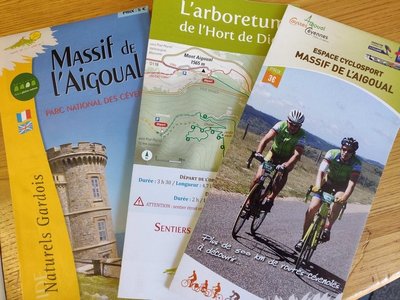
le Pole Nature de l'Aigoual - Béatrice Galzin  Natural environment
Pôle Nature 4 Saisons
The Pôle Nature 4 Saisons of the Aigoual massif offers outdoor activities in all seasons in the central zone of the Cévennes National Park, overlooked by the legendary summit of Mont Aigoual (1,570 m). Discover our network of trails on foot, on horseback, by bike, or else by mountain-bike or with a donkey, as the fancy takes you!
Children can explore the orienteering circuit or geocaching.
For the sportier among you we have laid out trail running circuits!
Prefer road biking? We have created circuits of varying difficulty levels so you can discover our villages and valleys.
Try not to make any noise! Wildlife enthusiasts can spot mouflons and other animals.
And if you would just like a gentle walk on the massif, the discovery trail “The cliffs of Mont Aigoual” is for you. There are various rest stops over its 4.5 km, with only 150 m in height difference.
We look forward to seeing you on our paths.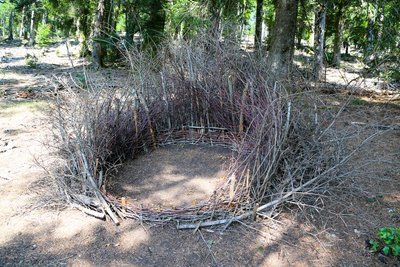
Nids (Céline Pialot) - © E. Fréget  Fauna
FaunaThe Nests (Céline Pialot)
Little by little, the bird makes its nest, its cosy nest, baby cocoon, wasps’ nest…
Like a bird, the artist has gathered materials offered by nature and has arranged them to build three nests, three refuges, three circles that reference perfection and invite meditation.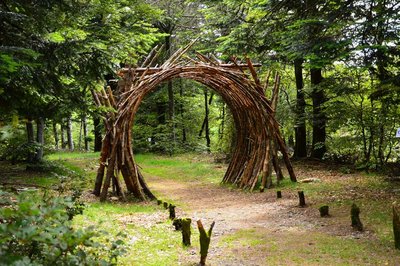
L'Orée (Yoann Crépin) - © Filature du Mazel  Know-how
On the Verge (Yoann Crépin)
A doorway to a circuit of art within the natural environment.
To fuse and interact with the environment and play with the seasons, time, light and weightlessness. To let humanity express itself through nature and nature express itself through humanity – a necessary interaction, a symbiotic interaction that inspires us to discover another world.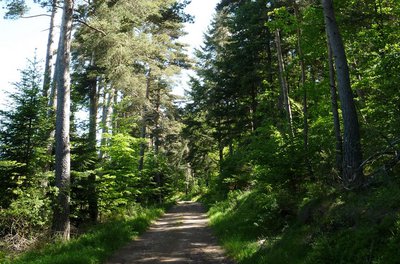
Chemin dans la forêt - Michel Monnot Natural environmentBeech trees and the Mont Aigoual forest
Beech is the main species of the Mont Aigoual forest, which consists of a large variety of trees adapted to the diverse soil types and exposure. Like most deciduous trees, beech stumps put out many shoots after a tree has been felled. Foresters select the best of these for timber. Old beeches can attain remarkable sizes, such as the beech in Le Suquet forest in the municipality of Camprieu, a vestige of the original forest that has come down to us through the centuries and has a circumference of six metres and a height of 25!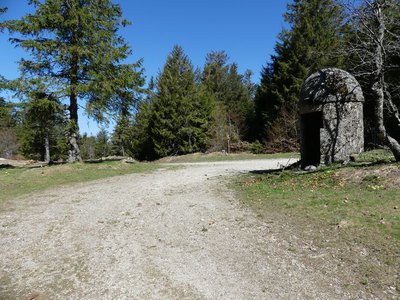
Col de la Caumette - nathalie.thomas HistoryThe salt road
La Caumette pass is on a former salt road. From Antiquity to modern times, salt has been a precious merchandise used for preserving food and tanning leather. Salt has always been traded and taxed during its transport inland from the Mediterranean coast. The sentry box at the pass was built in the 16th or 17th century at a strategic point at the crossroads of several roads, both to levy the salt tax and for surveillance against smuggling.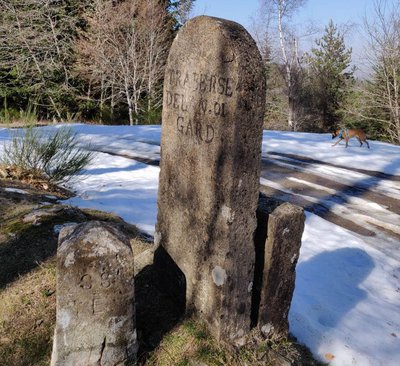
Route Royale - Béatrice Galzin HistoryFrom canons to the King’s Road
Have you noticed that you are on an ancient path?
Let’s plunge into history… Around the year 1000, this track was called Camin Ferrat and was used by transhumant shepherds and their flocks, pilgrims and merchants between Meyrueis and Le Vigan. From the latter, it passed through Mandagout, L'Espérou and the Col de la Serreyrède pass before descending to Bonheur Abbey and going back up to La Croix de Fer and reaching Meyrueis. This important mule track enabled trade between the Mediterranean and Meyruies. The Baron de Roquefueil, the region’s lord, had an abbey built below it, in the Bonheur valley, to aid travellers lost in the mountains. In the late 11th century, he founded a religious community of six canons who performed religious services and, in bad weather, rang the “bell for the lost” at regular times to guide passers-by in danger. The Abbey was abandoned in 1790. In the 18th century, the Camin Ferrat was disused in favour of the King’s Road, which you follow from the Col de la Caumette pass to Meyrueis. This new route went via the Col de la Serreyrède and the Col de la Caumette, after which it followed the ridge. The wall that you walk alongside from La Caumette and La Croix de Fer might be a vestige of the King’s Road or else the limit of the Bonheur Abbey estate. The secret remains, only our ancestors knew…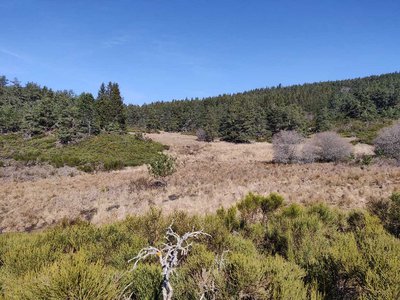
Zone humide - Béatrice Galzin  Water
WaterWetlands
Above the path, the soft sound of trickling water… These are wetlands, a fragile zone that must be protected. The peatbog is made up of rushes, sedge and many types of moss, such as sphagnum. Numerous insects live here, such as the large marsh grasshopper and dragonflies, as well as the common frog. If you make little noise, you may see deer here, or other animals that have come to cool down.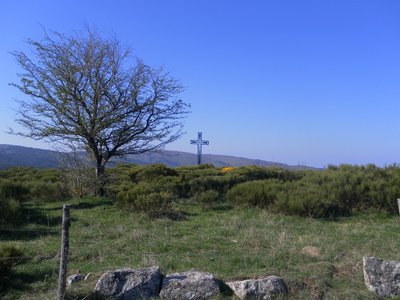
Col de la croix de fer - nelly Carel HistoryCol de la Croix de Fer pass
At the col de la Croix de Fer pass, which is a strategic crossroads of several tracks, there used to be an inn for travellers. The magnificent ruin with its two impressive vaults was also a sizeable farm, owned by the Baron de Roquedols. It was located at the limit of the municipalities of Meyrueis and St-Sauveur-Camprieu on the route of the Camin Ferrat and the King’s Road. In the days of religious persecution, the preacher François Vivens* organised secret Protestant gatherings in the small valley just below the buildings. (*Vivens was killed in 1692, 10 years before the Camisard War)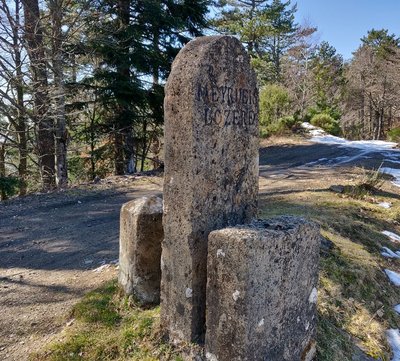
La Pierre Plantée - Béatrice Galzin HistoryPierre plantée (Pierre plantée)
Since ancient times, stones have stood along the Camin Ferrat: directional markers indicating a crossroads. Above all, they marked the boundaries of two parishes. Since the creation of Departments in 1790, they have outlined the border between Gard and Lozère.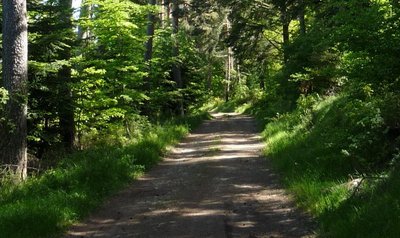
La piste en forêt - Michel Monnot HistoryThe Commanders
You are on a ridge path on the so-called “Commanders’ crests”. It is the last trace of the fact that this area belonged, from 1312 onwards, to the Knights Hospitaller and then to the Knights of Malta, who were based at the nearby hamlet of Servillières, at their “Commandery of Meyrueis and Servillières”. You are here on the border between the Gard and Lozère, marked by a standing stone. This ridge path is called the “wolf pen drovers’ road”, a variant thousands of years old of the main drovers’ road of La Lusette between L'Espérou and Meyrueis. Transhumant livestock would overnight here, in a closed-off space safe from wolves.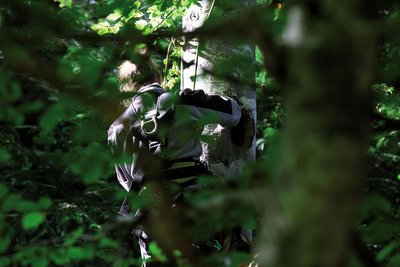
L'arbre et la vie - Gaël Karczewski Know-howForest management
The Mont Aigoual forest.
The wood harvested here comes from a forest that was reforested from the late 19th century onwards, after a period of overgrazing. This forest begins, grows and dies like all living beings. The job of foresters is to manage and support its development while respecting the laws of nature. They harvest trees before they die to make room for young trees. These tree trunks supply an entire economic sector, from the lumberjack to the skidder operator, the saw operator and the carpenter or cabinetmaker. Wood also accompanies you throughout your lives, from your cradle, furniture, woodwork and the wooden frame of your house to your coffin.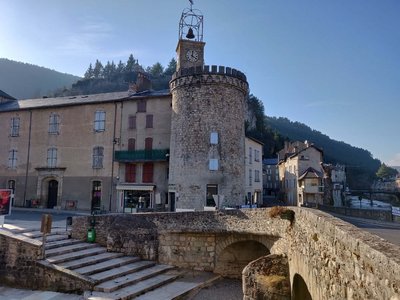
Le centre de Meyrueis et sa tour - Béatrice Galzin  Architecture
The village of Meyrueis
The geographical location of Meyrueis is remarkable, nestled between the Aigoual massif, the causse Noir and the causse Méjean. Here the Camin Ferrat crosses the Jonte river. Pilgrims and transhumant flocks of sheep stopped in the village before continuing their journey. Many merchants came to its large fairs. Stroll through the lanes and relive the flourishing past of the belle époque. From the prosperous bourgeois residences to the marketplaces, everything still speaks of the past! Sheep’s wool from the plateaux was woven here, silk was spun. There was intense economic activity. In the 17th century, Meyrueis became a centre for hat-making. By 1860, 17 milliners were busy making hats for Languedoc and Provence, beautiful and exceptionally high-quality hats made from felted wool and silk bourette. Discontinued as of about 1920, this activity left room for tourism, which today animates the village.
Description
- Day 1: 19 km. Starting from Meyrueis, follow the GR®66 long-distance hiking trail to Cabrillac. At that hamlet, leave the GR®66 for the GR®60, which climbs to the top of Mont Aigoual via Le Plo du Four.
- Day 2: 20 km. From Mont Aigoual, head back down on the GR®6 to the Prat Peyrot resort, then continue always along the GR®6 towards Meyrueis via La croix de fer and Bout de Côte.
- Departure : Meyrueis
- Arrival : Meyrueis
- Towns crossed : Meyrueis, Gatuzières, Rousses, Bassurels, Val-d'Aigoual, Saint-Sauveur-Camprieu, and Lanuéjols
Forecast
Altimetric profile
Recommandations
Make sure your equipment is appropriate for the day’s weather conditions. Remember that the weather changes quickly in the mountains. Take enough water, wear sturdy shoes and put on a hat. Please close all gates and barriers behind you.
Caution: patous (livestock guard dogs)! Seek advice on how to behave near these dogs from tourist offices and National Park information centres.
Information desks
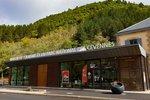
Tourism'house and national Parc at Florac
Place de l'ancienne gare, N106, 48400 Florac-trois-rivières
This office is part of the National Park's associated tourist-information network, whose mission is to provide information on, and raise awareness of, the sites and events as well as the rules that must be observed in the National Park's central zone.
On site: exhibitions, video projections, events and shop Open year-round
Transport
Place Sully
Bus line "Meyrueis-Millau" July and August
https://lio.laregion.fr/IMG/pdf/oc-1903-fhbus-48-257-3v_bd_04_.pdf
Daily year-round. Different timetables for term time or school holidays:
Line 215 Autocars Causse + 33 (0)6 65 61 24 16
Access and parking
Meyrueis, via the Jonte gorge on the RD 996.
Parking :
Calculateur d'itinéraire Lio
Utilisez le calculateur liO pour organiser votre trajet en région Occitanie.
Autres régions
Calculez votre itinéraire en Auvergne Rhône Alpes sur Oùra
Biodiversité autour de l'itinéraire
Source
Report a problem or an error
If you have found an error on this page or if you have noticed any problems during your hike, please report them to us here: