
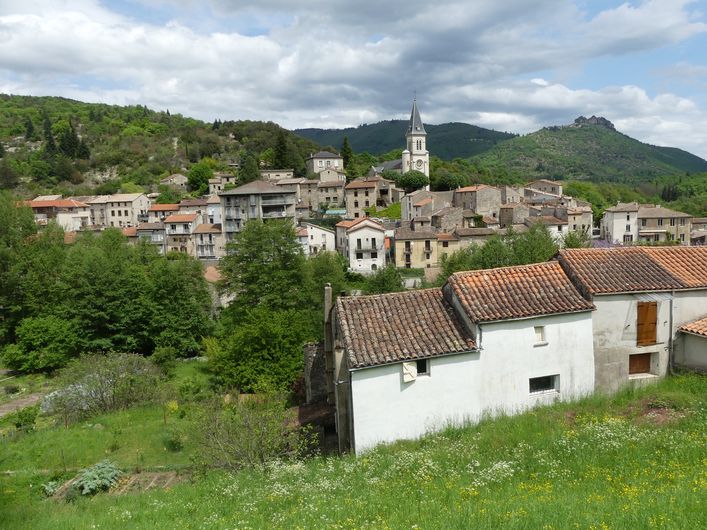
The hosiers
3 points of interest
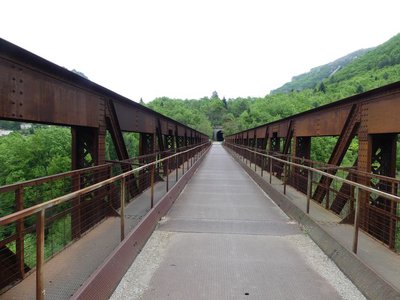
Le viaduc de Lavassac - Nathalie Thomas  History
The Lavassac viaduct
This steel bridge with a span of 80 metres and a weight of 418 tonnes was conceived by Gustave Eiffel in the late 19th century for the railway. A landowner whose parcels lay below the viaduct is believed to have won a lawsuit for damages because of the shade thrown by the bridge... Today, the section between Arre, Bez et Esparon and Molières-Cavaillac has been transformed into a walking and cycling path, accessible for non-motorised users, whether children or adults: 3.5 km to enjoy en famille, without danger, with little elevation gain and with two tunnels lit by solar energy.
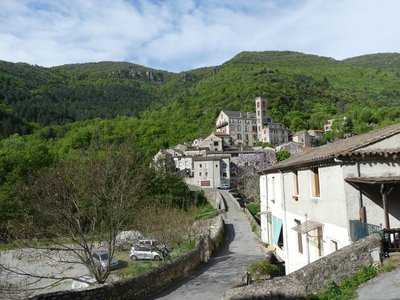
Orphelinat d'Arre - Nathalie Thomas HistoryThe former orphanage
At the foot of the village, on the left, a building overlooking the river has a particular style. This is the former orphanage, which closed down in the early 20th century. Sainte Anne was home to poor young girls without families who mainly came from the Aveyron department. They worked in the village factory to unthread the silk it onto the spools. After work, they had to clean the orphanage and chapel as well as take care of the pigs and poultry. On the site of the orphanage there was a chapel, Sainte-Marie d'Arre. By popular demand, it was rededicated to Saint-Blaise, patron saint of weavers and carders.

Maison de la famille Brun - Nathalie Thomas HistoryThe hosiery industry and Arre
Shortly after the church, on the left, you will see the Brun family residence and the dyeing factory. The railings of the factory gates came from the Château des Tuileries in Paris, which had been burned down in 1870. The village’s prosperity was linked to the hosiery industry and the Brun d'Arre company. This hosiery business, the oldest in the region, was first recorded in 1740. In the 1880s, the factory’s looms were mechanised to produce silk hosiery. Modernisation continued with the purchase of heavy-duty looms for cotton articles. In 1906, the company created the first brand of silk stockings, Lys stockings, which became internationally known. A fleur-de-lys was embroidered onto the stockings by workers working at home. In 1924, there were 600 of these workers. The combustible necessary for the industry to develop was supplied by the coal mines in Cavaillac, 7 km away.
Description
Signposts will guide you all along this route. In the description below, the signposted place names and/or directions are given in bold italics between quotation marks:
Start at the former train station at the signpost “Foyer d'Arre”. Walk towards “Arre-Mairie”.
- Then turn right to climb towards “La Murette”.
- Continue to "Campsavy", "Laussou" and "Lasalle".
- At “Lasalle”, optional there-and-back into the village to reach the viewpoint.
- Then go downhill to “Bez”, “Pont de la Grave" and “Viaduc Lavassac”. At the viaduct, there-and-back to the viewpoint over the village and its surroundings.
- Return to the car park along the banks of the Arre via “Arre-Pont Vieux”,
- "Arre-Mairie”, “Foyer d'Arre”.
This walk is taken from the guidebook Les Vallées Cévenoles - En Pays Viganais, published by the Communauté de communes Pays Viganais-Cévennes as part of the collection Espaces Naturels Gardois and the label Gard Pleine Nature.
- Departure : Information panel ARRE
- Arrival : Information panel ARRE
- Towns crossed : Arre and Bez-et-Esparon
Forecast
Altimetric profile
Recommandations
Make sure your equipment is appropriate for the day’s weather conditions. Take enough water, wear sturdy shoes and put on a hat. Please close any gates and barriers behind you.
Information desks

Tourism office Cévennes and Navacelles, Le Vigan
Maison de pays, place du Marché, BP 21, 30120 Le Vigan
This office is part of the National Park's associated tourist-information network, whose mission is to provide information on, and raise awareness of, the sites and events as well as the rules that must be observed in the National Park's central zone.
Open year-round
Access and parking
From Le Vigan on the D999, towards Bez-et Esparon, Arre.
Parking :
Calculateur d'itinéraire Lio
Utilisez le calculateur liO pour organiser votre trajet en région Occitanie.
Autres régions
Calculez votre itinéraire en Auvergne Rhône Alpes sur Oùra
Biodiversité autour de l'itinéraire
Source


Report a problem or an error
If you have found an error on this page or if you have noticed any problems during your hike, please report them to us here: