Hort de Dieu Trail
 Yellow waymarks
7 points of interest
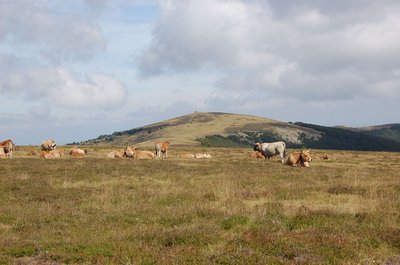
Troupeau au sommet de l'Aigoual - © Nathalie Thomas  Flora
FloraSummit of Mont Aigoual
At an altitude of 1,565 m, the climate is harsh: weather conditions are the same as they would be at 2,000 m elsewhere, with only four “frost-free” months a year. Winds of above 60 kph blow on 265 days a year, and the average annual temperature is 4.8°C. Trees do not have enough time to complete their life cycle. Local plant formations are those of the montane zone: subalpine short-grass prairies.
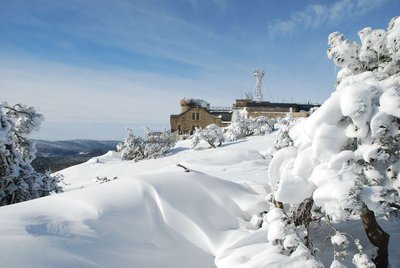
L'Aigoual sous la neige - © Météosite du Mont Aigoual  History
Mont Aigoual weather station
Inaugurated in 1894, this infrastructure is France’s last mountain weather station to be inhabited. Its history is closely linked to the reforestation of Mont Aigoual. It has become a high-performance weather station with an array of modern test instruments, measuring devices for extreme conditions, and a museum/exhibition on meteorology. The 800 sq m exhibition will tell you more about climatology on Mont Aigoual and about meteorology in general.
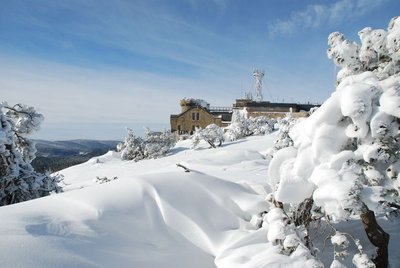
L'Aigoual sous la neige - © Météosite du Mont Aigoual HistoryMont Aigoual weather station
Inaugurated in 1894, this infrastructure is France’s last mountain weather station to be inhabited. Its history is closely linked to the reforestation of Mont Aigoual. It has become a high-performance weather station with an array of modern test instruments, measuring devices for extreme conditions, and a museum/exhibition on meteorology. The 800 sq m exhibition will tell you more about climatology on Mont Aigoual and about meteorology in general.
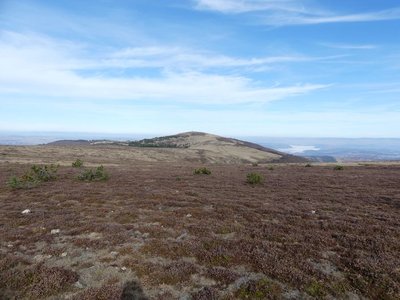
Le Portalet - nathalie.thomas FloraShort-grass prairies and heath on the summit of Mont Aigoual
Here, only species with a short reproductive cycle can settle due to the frequently glacial climate. The heath has been invaded by heather and mountain pine. This zone is barely wooded due to the violent winds and is comparable to subalpine vegetation, consisting of short-grass prairies and heather and blueberry moor. It is sometimes called pseudo-alpine.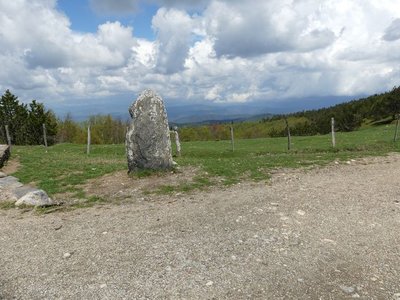
Vue depuis Font de Trépaloup - nathalie.thomas FloraThe evolution of plant life
At the pass stands a schist menhir (standing stone). To the north, in Trépaloup ravine, hewn flint implements bear witness to a human presence in the region since prehistoric times. Palynological analyses (studies of pollen fossilised in peatbogs) have allowed scientists to piece together the plant life on Mont Aigoual from 8,000 to 5,000 BC. Pine predominated, accompanied by birch and hazelnut. Then pine populations gradually diminished. The damp climate warmed up, favouring the spread of oak and hazelnut. Finally, the increased damp and cloud cover at altitude allowed fir and beech to develop. From the end of the first century BC, the substantial percentage of grasses shows that forest had receded in favour of pasture and prairies. This was the start of the great deforestation.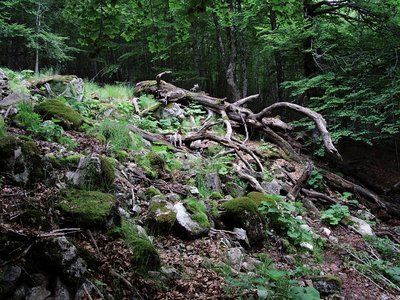
Forêt de l'Aigoual - © Gaël Karczewski HistoryA site for botanical experiments
Marker 1
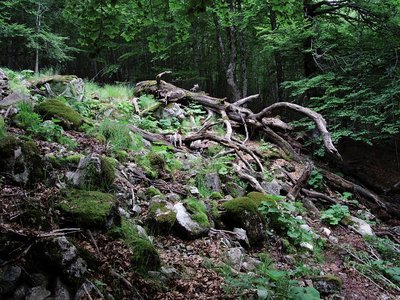
L’Hort de Dieu is located at an altitude of 1,300 m and shaped by an extreme climate. This site with its exceptional assets is a favoured study and experimentation zone for botanists. The tree collection is just over 100 years old, and some of the specimens are declining because of old age or else because they are not well-adapted to this mountain range. Today, there are 75 species left of the 140 that have been tested over the past century. To safeguard the interest of this heritage site, the Office National des Forêts and the Cévennes National Park are currently reflecting on renewing the collection.
Forêt de l'Aigoual - © Gaël Karczewski HistoryA site for botanical experiments
Marker 1
L’Hort de Dieu is located at an altitude of 1,300 m and shaped by an extreme climate. This site with its exceptional assets is a favoured study and experimentation zone for botanists. The tree collection is just over 100 years old, and some of the specimens are declining because of old age or else because they are not well-adapted to this mountain range. Today, there are 75 species left of the 140 that have been tested over the past century. To safeguard the interest of this heritage site, the Office National des Forêts and the Cévennes National Park are currently reflecting on renewing the collection.
Description
Signposts will guide you all along this route. In the description below, the signposted place names and/or directions are given in bold italics between quotation marks :
From “Station de Prat Peyrot”, run to “Sommet du Mont Aigoual” via:
- “Draille de Calcadis”,
- “La Drailhe”,
- “Les Antennes”,
- “Carrefour”.
- At “Sommet” go downhill to:
- “Menhir du Trépaloup”. Continue downhill to “L’Hort de Dieu” via:
- “L’Apollon”,
- “Le Grel”,
- “Les Mughos”,
- “L’Hort de Dieu Nord”.
- From “L’Hort de Dieu”, return to “Station de Prat Peyrot” via:
- “Le point sublime”,
- “Muraille de Volpellière”,
- “Valat de la Dauphine”,
- “Stèle de C. Flahault”.
This trail is taken from the guidebook Massif de l’Aigoual, published by the communauté de communes Causses Aigoual Cévennes as part of the collection Espaces naturels gardois and the label Gard Pleine nature.
- Departure : Station Prat Peyrot
- Arrival : Station Prat Peyrot
- Towns crossed : Meyrueis, Val-d'Aigoual, and Bassurels
Forecast
Altimetric profile
Recommandations
Before committing yourself to a circuit, ensure that it is suitable for your activity level and ability. Remember that the weather changes quickly in the mountains. Take enough water. Please close all gates and barriers behind you.
Information desks

Tourism & national parc'house
Col de la Serreyrède, 30570 Val d'Aigoual
The Maison de l'Aigoual houses the tourism office Mont Aigoual Causses Cévennes and the Maison du Parc national. This visitor centre provides information on and raises awareness of the Cévennes National Park, its sites and events as well as the rules that must be observed in the National Park's central zone.
On site: changing exhibitions, video projections, Festival Nature events and shop Open year-round
Transport
LiO is the regional public transport service of the Occitanie/ Pyrénées – Méditerranée region. It facilitates everyone’s movements by prioritising public transport. For more information, go to the lio Occitanie app or visit https://www.mestrajets.lio.laregion.fr
Access and parking
From St-Sauveur-Camprieu, take the D986 to the Col de La Serreyrède pass; then take on your left the D269 to Station de Prat Peyrot – car park.
From Valleraugue, take the D986 to L’Espérou, then to the Col de La Serreyrède pass. At the pass, take on your right the D269 to Prat Peyrot.
Parking :
Calculateur d'itinéraire Lio
Utilisez le calculateur liO pour organiser votre trajet en région Occitanie.
Autres régions
Calculez votre itinéraire en Auvergne Rhône Alpes sur Oùra
Biodiversité autour de l'itinéraire
Source


Report a problem or an error
If you have found an error on this page or if you have noticed any problems during your hike, please report them to us here: