

From valley to valley – between Gardon and Tarnon (day 2)
 Yellow waymarks
 GR (long-distance hiking path)
 GRP (regional long-distance hiking path)
8 points of interest
© Béatrice Galzin  History
The age of silk
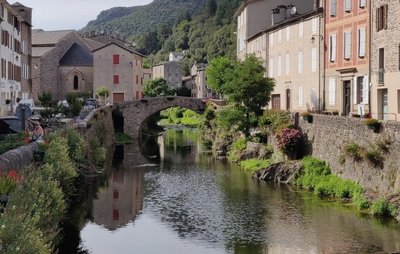
From the 19th century onwards, the silk industry developed in the Cévennes: tanneries gave way to spinning mills. The mills used water not only to treat the silkworm cocoons (which were boiled to prepare the silk) but also for the steam-driven spinning machines. In the second half of the 19th century, diseases strongly reduced silk production, which was also subject to competition from foreign silks and then from artificial silk. The silk industry went under in 1965.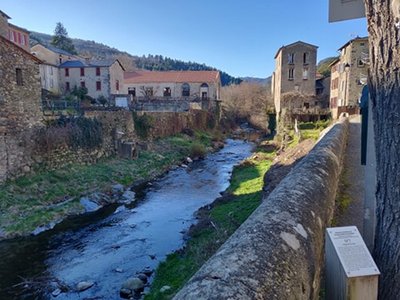
© Béatrice Galzin HistoryThe tanners’ district
La Calquière district gets its name from that of the ditches in which the tanners soaked their animal skins with limestone, which is called cauç or calç in Occitan. All along the Gardon there were tanneries because its acidic water was good for rinsing the skins, which was indispensable for obtaining high quality products.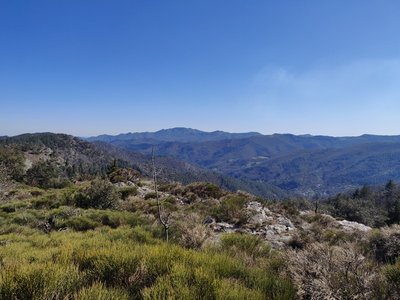
Le col - Béatrice Galzin HistoryLique Ser
Lique Ser path goes up to the famous Corniche des Cévennes, a ridge between the two departments of Gard and Lozère. This road, which is busy these days in summer because of its superb views, has not always been a holiday address.
In the days of Louis XIII and XIV, this was the route of the dragonnades and the repression of Protestantism by the King’s army after the Revocation of the Edict (the billeting of deliberately ill-disciplined soldiers in Protestant households) of Nantes. This ridge gave the soldiers, known as the King’s dragoons, strategic viewpoints. The road was abandoned from the 19th century onwards. In 1930, after lengthy renovations, it was opened to traffic again, becoming a major tourist route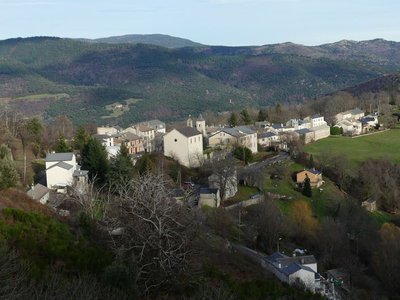
Le Pompidou - nathalie.thomas HistoryLe Pompidou
Le Pompidou, like Saint-Roman de Tousque, owes its development to its location on the Corniche des Cévennes road. From the 17th century onwards, this former mule track carried substantial trade, with mule cart drivers bringing up salt, wine and dried fish from southern France to the Gévaudan, taking grains and cloth down from the uplands, and exporting the silk and chestnuts of the Cévennes. You can still see two buildings, the former inn (Le Cheval Blanc) and the Chapeau Rouge staging post, where travellers changed carriage horses.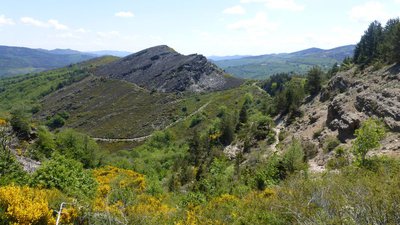
Col de Tartabissac - nathalie.thomas AgricultureSmall buildings
The small buildings you see dotted here and there are jasses (from jas: place where livestock sleeps), sheepfolds of times gone by. There used to be at least 20 between Tartabissac and Bézuc. From the first warm days to 6 December, livestock would spend the night here, and their owners would come up during the day to watch them. An old saying goes, “No livestock in the chestnut groves before the sixth of December”. 6 December was the date of the fair in Florac when the local chestnuts were sold. Today Bézuc hosts 200 sheep for 8 months of the year.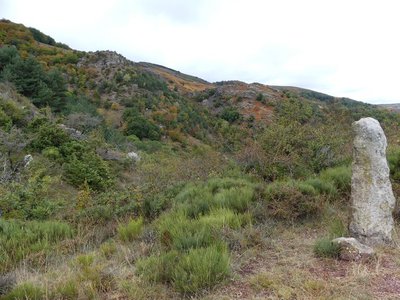
Vue sur La Can depuis le col de Tartabisac - nathalie.thomas  Geology
Contact
At the Col de Tartabisac pass, there is a clear limit between the two bedrocks: on the left, the limestone plateau; on the right, a schist slope. The two rocks are in contact at a geological fault. A layer of very wet sandstone sits at the level of the meadows, at the foot of the limestone. This is where the water that has infiltrated via the thick layers of the Can plateau re-emerges.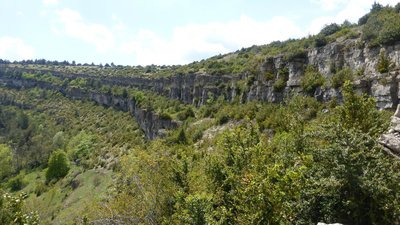
Descente sous Les Crottes - nathalie.thomas GeologySchist, limestone or granite
From the track, you can make out the hamlets on the side of the valley at the foot of the Can: Roumassel, Le Crouzet, Le Crémat, Le Masbonnet. The land stretching from the valley floor to the plateau belongs to these hamlets, including chestnut groves, pasture and parcels for growing grains. After Bézuc, the bedrock is partly schist, where broom and heather grow, partly limestone, which is linked to the presence of the carline thistle. In a meadow beyond the beech forest, you can see blocks of granite, which stem from a vein linking Mont Aigoual to Mont Lozère. The ruiniform rocks on the plateau were shaped by water, which infiltrates fractures in the rock and dissolves the dolomite that they are made of.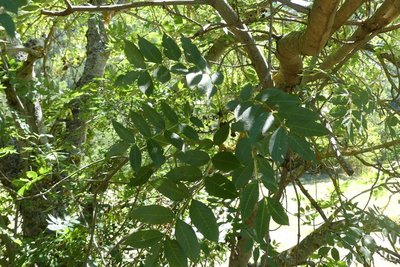
Frêne commun - Nathalie Thomas  Flora
FloraAsh trees
Ash trees, like the ones that border the path, like cool and damp environments. They were planted alongside paths by locals because ash branches, cut towards the end of summer, provided additional fodder for livestock.
Description
Starting from St-André de Valborgne, walk towards “Le Pompidou” on the GRP® long-distance path Tour de la Haute-Vallée Borgne (yellow and red waymarks).
- At the reservoir at Le Serre, take the path that goes uphill.
- Once on the track, go downhill opposite through the forest of conifers, then turn left onto the path. Pass the houses “Folie” and “Le Pompidou”.
- At Le Pompidou, go uphill through the village on the left (D9 road) to the fountain, turn right and walk to “Tartabissac”.
- Then “Bézuc” and “L’Hospitalet”, always following the red and yellow waymarks.
- At “L’Hospitalet”, cross the D9 and take the dirt path opposite (GR®7-67), waymarked red and white.
- At point 1058 on the map, take the path on your right that takes you back to the village of Rousses.
- Departure : St-André de Valborgne
- Arrival : Rousses
- Towns crossed : Saint-André-de-Valborgne, Le Pompidou, Vebron, and Rousses
Forecast
Altimetric profile
Recommandations
Avoid the section from the Col de Tartabisac pass to Bézuc after heavy rain : rivers and brooks will be flooded.
Make sure your equipment is appropriate for the day’s weather conditions. Remember that the weather changes quickly in the mountains. Take enough water, wear sturdy shoes and put on a hat. Please close any gates and barriers behind you.
Information desks

Information center Le Pompidou
La poste, 48400 Le Pompidou
This centre is part of the National Park's associated tourist-information network, whose mission is to provide information on, and raise awareness of, the sites and events as well as the rules that must be observed in the National Park's central zone. :
Open year-round

Tourism & national parc'house
Col de la Serreyrède, 30570 Val d'Aigoual
The Maison de l'Aigoual houses the tourism office Mont Aigoual Causses Cévennes and the Maison du Parc national. This visitor centre provides information on and raises awareness of the Cévennes National Park, its sites and events as well as the rules that must be observed in the National Park's central zone.
On site: changing exhibitions, video projections, Festival Nature events and shop Open year-round
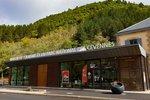
Tourism'house and national Parc at Florac
Place de l'ancienne gare, N106, 48400 Florac-trois-rivières
This office is part of the National Park's associated tourist-information network, whose mission is to provide information on, and raise awareness of, the sites and events as well as the rules that must be observed in the National Park's central zone.
On site: exhibitions, video projections, events and shop Open year-round

Office de tourisme Des Cévennes au mont Lozère
le Quai, 48220 Le Pont de Montvert sud mont-Lozère

Tourism office Mont Aigoual Causses Cévennes, Saint-André-de-Valborgne
les quais, 30940 Saint-André-de-Valborgne
This office is part of the National Park's associated tourist-information network, whose mission is to provide information on, and raise awareness of, the sites and events as well as the rules that must be observed in the National Park's central zone.
Access and parking
D907 St-André de Valborgne.
Parking :
Calculateur d'itinéraire Lio
Utilisez le calculateur liO pour organiser votre trajet en région Occitanie.
Autres régions
Calculez votre itinéraire en Auvergne Rhône Alpes sur Oùra
Biodiversité autour de l'itinéraire
Source

Report a problem or an error
If you have found an error on this page or if you have noticed any problems during your hike, please report them to us here: