
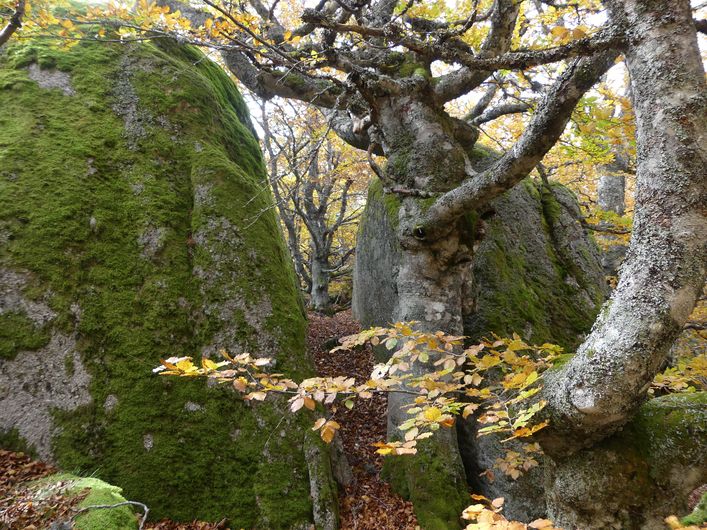
Bayard, MTB circuit #6 (green)
 mountain-bike
A little loop for the whole family that takes the discovery trail " Exploring the magical forest" in the opposite direction.
9 points of interest
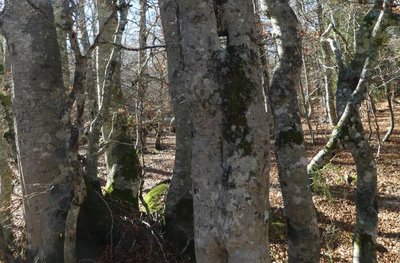
Hêtre soudé (anastomose) - © E. Balaye  Flora
FloraTree kisses
Among trees, there is strength in unity. Trees like to merge with others via the roots – it makes them stronger. But here, there are beeches that have grown together at the branch level or even at the trunk. Strange bonds! Try to spot them but do not disturb them.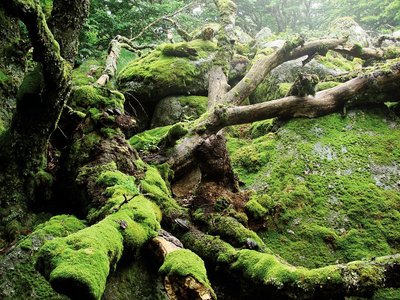
Arbres morts - © Mathieu Baconnet  Natural environment
The death of a tree
A dying or dead tree makes us a little sad. And yet it regenerates the forest. Once the tree is dead, it still provides refuge for fauna over many years. Its rotting wood feeds legions of small animals, which turn an old forest into a living treasure. The larvae of the bronze carabid devour slugs and snails while the larvae of the longhorn beetle burrow into dead wood.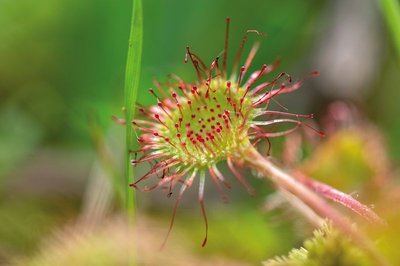
Drosera rotundifolia - © Yannick Manche  Water
WaterThe peat bog: a world apart
This natural environment is a strange world where only very particular plants survive. Sundew (drosera) is the star of the peat bog. The soil is so poor here that the plant catches insects to feed on; it is carnivorous. The water is very acidic and contains very little oxygen here. When plants die, they do not decompose as well as in the forest. Instead they accumulate to form a thick layer of peat.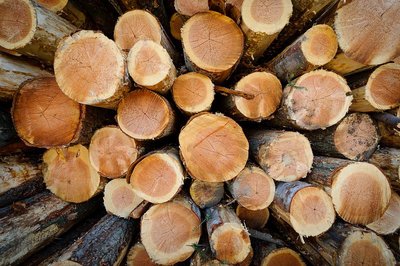
Exploitation de bois - © A. Bouissou/TERRA Natural environmentHumans and the forest
In some places, you can see that trees have been felled. Why? The paint marks differentiate trees to be felled from those that will be preserved according to economic and ecological criteria. In the forest at Mas de la Barque, we have to ensure that the forest ecosystem works well. It is a resource to be preserved for the future. Let us watch the forest technician at work.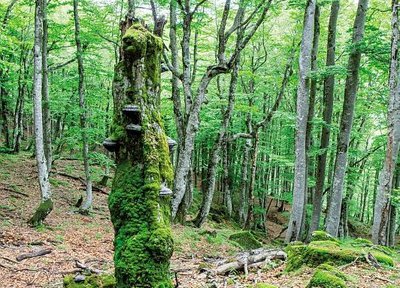
Arbre mort - © KARCZEWSKI Gaël FloraMeet a tinder fungus
The fat mushroom stuck to the trunk of an old beech is a tinder fungus, a tree parasite. From above, it looks like a cep cap. Below, fine tubes are full of spores, the little cells that allow the fungus to reproduce. Tinder fungus is totally inedible. So what might it be used for? Once dried, it catches fire at the first spark. Prehistoric humans used it to light their fires.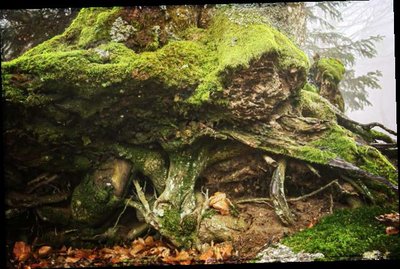
Sous-sol forestier - © PNC Natural environmentThe secret life of the subsoil
Did you know that, as you walk through the forest, you are trampling a little-known world? Under your feet a multitude of tiny creatures are tirelessly active: by decomposing organic matter, such as dead leaves, they enable tree roots to absorb nutrients. Without them, there would be no forest. Below the roots, this tree gives you a glimpse of the subsoil. Let us see what it hides.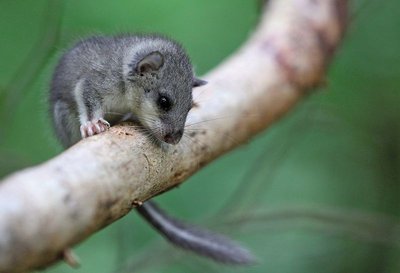
Loir gris - © R. Descamps Natural environmentA real village
During their lifespan, these trees grow crooked, swell, become wrinkled. A ripped-off branch leaves a scar open to bird beaks. Towards the end of its life, the old tree is full of cavities – comfortable nests for small animals. Can you hear a soft whoo hoo hoo in the forest? That is a boreal owl. The black woodpecker carves its nest out of dead wood using its powerful beak. The European edible dormouse, a rather pretty rodent, hides its food stores in holes in old beeches.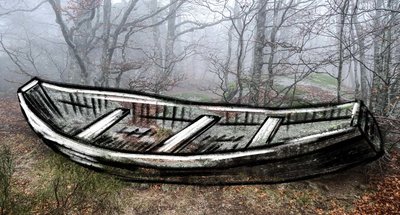
Rocher de la Barque - © Biotope  Tradition
The mysterious boat
Have you noticed the strange rock shaped like a boat (barque)? Is that what gave the hamlet its name? Alternatively, in the local patois, a berque is a gap in the mountain. So: Mas de la Barque or Mas de la Berque?
Mas de la Barque is part of the municipality of Vialas and borders the forest of Gourdouze. The estate of the Priory of Gourdouze, to which the forest once belonged, was declared government property during the French Revolution in 1789, before being sold to pay the state’s debts.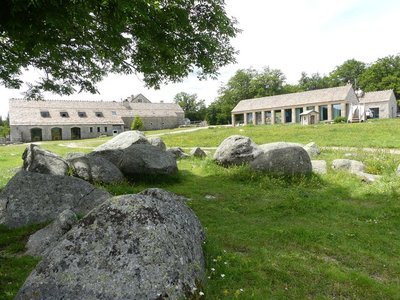
Mas de La Barque - nathalie.thomas  History
Le Mas de La Barque
Le Mas de La Barque was only a forester’s house at the end of the 20th century. From the 1960s onwards, it was frequented by children’s ski clubs and then by families from the Gard on the weekend. During the week, the association “Union pour l'Animation de la Grange” organised field trips, heritage classes and theme days open to all. A costly infrastructure was gradually built (buildings, ski lifts, snow canons), then partly demolished again. Today, as part of an overall programme of reclassifying the site, it has been developed for tourism (cross-country skiing, snowshoeing, dog-sledding, etc.) and is run by a semi-public company. The resort offers outdoor activities in summer as well as in winter.
Description
Follow the MTB markup n°6
Signposts will guide you all along this route, as well as yellow painted waymarks. In the description below, the signposted place names and/or directions are given in bold italics between quotation marks :
Starting from “Mas de La Barque”, bike to :
- “Martelet”,
- “La Grande Forêt”,
- “Passerelle de Bayard”,
- “Bergerie de Bayard”. At “Bergerie de Bayard”, turn left, return to “Mas de La Barque” via :
- “Rochers de la Barque”,
- “Les écuries du Mas de la Barque”.
This MTB circuit is taken from the guidebook Mont Lozère – Pays des sources, Sommet des Cévennes, published by the Pôle de pleine nature du Mont Lozère.
- Departure : Mas de La Barque
- Arrival : Mas de La Barque
- Towns crossed : Vialas and Pont de Montvert - Sud Mont Lozère
Forecast
Altimetric profile
Recommandations
No off-roading. You are strongly encouraged to wear a helmet. Do not forget your repair kit and a small tool kit. Close barriers and gates behind you. Slow down in farms and hamlets.
Information desks
Tourism'house and national Parc at Florac
Place de l'ancienne gare, N106, 48400 Florac-trois-rivières
This office is part of the National Park's associated tourist-information network, whose mission is to provide information on, and raise awareness of, the sites and events as well as the rules that must be observed in the National Park's central zone.
On site: exhibitions, video projections, events and shop Open year-round
Tourism'house and national parc, Génolhac
Place du Colombier, 30450 Génolhac
This office is part of the National Park's associated tourist-information network, whose mission is to provide information on, and raise awareness of, the sites and events as well as the rules that must be observed in the National Park's central zone.
Open from april to october

Tourism office Mont-Lozère, Villefort
43, Place du Bosquet, 48800 Villefort
This office is part of the National Park's associated tourist-information network, whose mission is to provide information on, and raise awareness of, the sites and events as well as the rules that must be observed in the National Park's central zone.
Open year-round
Access and parking
From Villefort on the D66.
From Génolhac on the D362 and then the D66.
Parking :
Calculateur d'itinéraire Lio
Utilisez le calculateur liO pour organiser votre trajet en région Occitanie.
Autres régions
Calculez votre itinéraire en Auvergne Rhône Alpes sur Oùra
Biodiversité autour de l'itinéraire
Source

Report a problem or an error
If you have found an error on this page or if you have noticed any problems during your hike, please report them to us here: