
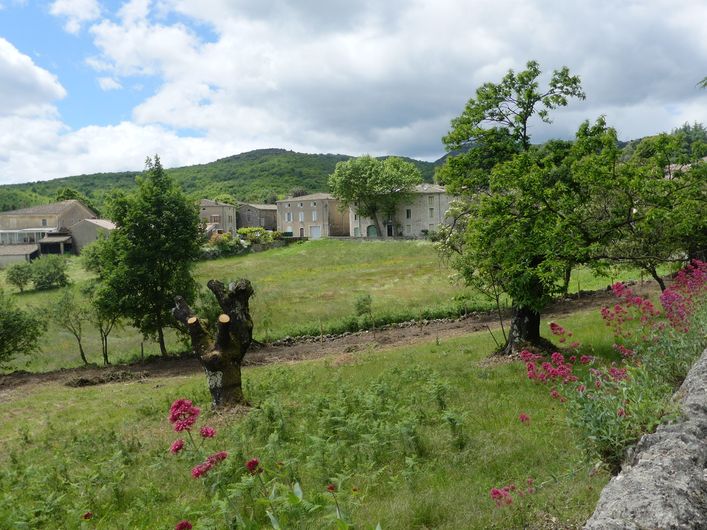
The Spinners' Path
 Yellow waymarks
4 points of interest
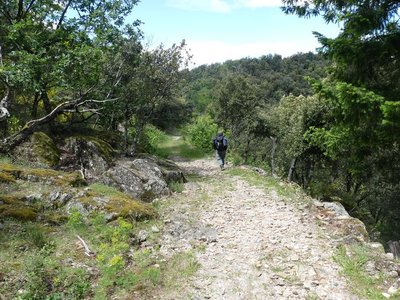
le chemin des fileuses - N Thomas  History
The Spinners' Path
This is the path the young girls took to reach Lasalle, where they worked in the spinning mills. The working day ran "from day to day", from dawn to nightfall, and followed the rhythm of the seasons: shorter in winter, it could reach sixteen to eighteen hours in summer.
Silk spinning brought real industrial growth throughout the Cévennes piedmont. In 1841, eight mills were working silk in the commune of Lasalle, whose population had doubled in 50 years to reach 2,500 people in 1850.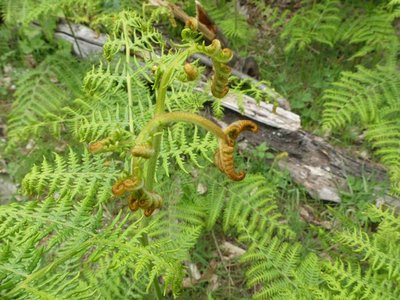
Fougère aigle - N Thomas  Flora
Bracken (Occitan name: Alacha)
In the Cévennes and on Mont Lozère, bracken was used to fill palliasses. Bracken mattresses were recommended to "strengthen the bones".
It was also used as bedding for all domestic animals. Cut while still green with a sickle and gathered into armfuls, it was left to dry for a day or two, then stored in the stable, where it was used all winter. This bracken bedding was reputed to be effective against fleas.
The rhizomes, rich in starch, were also given to pigs, raw or cooked in a mash of potatoes and nettle, the leaves being toxic.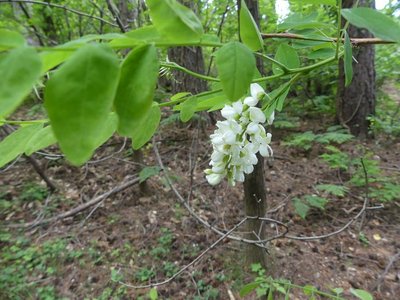
L'acacia et sa fleur - N Thomas FloraThe black locust (Occitan name: Cacièr)
The black locust has been used for centuries, for its wood as well as for culinary and medicinal purposes. Its clusters of fragrant flowers are used fresh to make fritters and syrups. Acacia honey, appreciated for its mild flavour, has a low glucose content.
In the Cévennes, these trees were planted to hold the banks of streams in place. In the Garrigues, whole trunks, slender and straight, were used to make cart shafts and vineyard stakes. It is resistant to pests and mould. Its wood is durable in clay soil, but has the drawback of warping when split.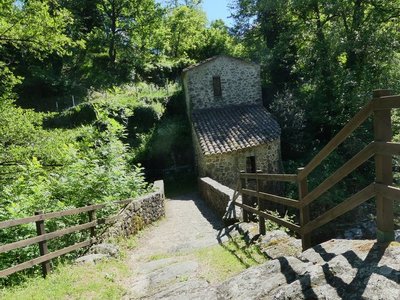
Moulin de la Mouleyrette - © N Thomas HistoryThe mill at la Mouleyrette
This mill, probably built between 1586 and 1596, is a grain mill (for grinding cereals: wheat, rye and barley) with two "roudets" (small horizontal water wheels) that drive the millstones directly. This simple, sturdy system is particularly well suited to the Cévennes "valats" (streams), whose flow is low in summer but can swell very suddenly. It is one of the few mills with two sets of millstones housed in two separate, adjoining buildings, driven by the same flow of water.
One may wonder whether this layout was designed to grind separately the grain coming from Monoblet and from Colognac. Indeed, the stream marked the boundary between two parishes which at the time (before 1789) belonged to two different dioceses.
The abandonment of the lower mill after the Revolution seems to support this. The mill stopped working around 1890. Almost one hundred years went by, and in 1968 the commune bought it. In 1991, a preservation association was founded to rebuild it and bring it back to life.
Description
Signposts will guide you all along this route. In the description below, the signposted place names and/or directions are given in bold italics between quotation marks:
From the "Colognac" car park, head towards "Le Roudieyret" on the GR®63, which you leave when you join the track to Bussas.
- Go down to the stream, cross the Nivoulède bridge and continue on the path that passes above the houses.
- At "Le Roudieyret", turn right and climb towards "Lascamps".
- At "Lascamps", take the road on your right towards "La Mouleyrette".
- From there you can go to the mill at La Mouleyrette and back. On your way back, head towards
- "Bernaden". Continue climbing to reach the car park.
This walk is taken from the guidebook Piémont Cévenol, Des Cévennes au Coutach, published by the communauté de communes du Piémont Cévenol as part of the collection Espaces Naturels Gardois and the label Gard Pleine Nature.
- Departure : Colognac
- Arrival : Colognac
- Towns crossed : Colognac and Lasalle
Forecast
Altimetric profile
Recommandations
Adjust your gear to suit the day’s weather conditions. Remember that the weather can change quickly in the mountains. Be sure to bring plenty of water, sturdy shoes, and a hat.
Information desks
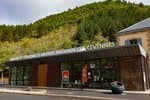
Tourism'house and national Parc at Florac
Place de l'ancienne gare, N106, 48400 Florac-trois-rivières
This office is part of the National Park's associated tourist-information network, whose mission is to provide information on, and raise awareness of, the sites and events as well as the rules that must be observed in the National Park's central zone.
On site: exhibitions, video projections, events and shop Open year-round

Tourism office Mont Aigoual Causses Cévennes, Lassale
Centre Viala, rue de la Place, 30460 Lasalle
This office is part of the National Park's associated tourist-information network, whose mission is to provide information on, and raise awareness of, the sites and events as well as the rules that must be observed in the National Park's central zone. : Open year-round
Tourism office Piémont Cévenol, Saint-Hippolyte-du-Fort
Cour d'honneur des Casernes, 30170 Saint Hippolyte du Fort
This office is part of the National Park's associated tourist-information network, whose mission is to provide information on, and raise awareness of, the sites and events as well as the rules that must be observed in the National Park's central zone.
Open year-round
Access and parking
From Anduze, head towards Thoiras, then Lasalle and Colognac.
Calculateur d'itinéraire Lio
Utilisez le calculateur liO pour organiser votre trajet en région Occitanie.
Autres régions
Calculez votre itinéraire en Auvergne Rhône Alpes sur Oùra
Biodiversité autour de l'itinéraire
Source

Report a problem or an error
If you have found an error on this page or if you have noticed any problems during your hike, please report them to us here: